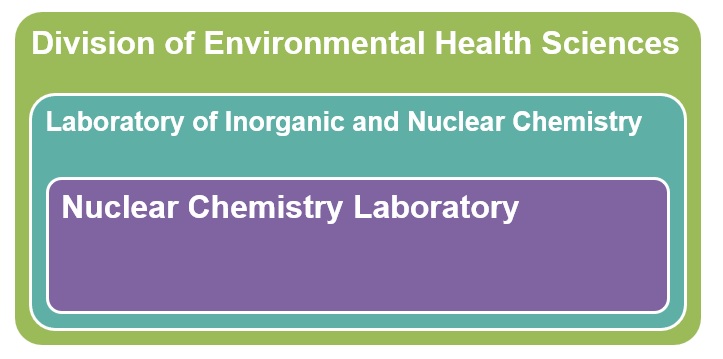
Wadsworth Center’s Nuclear Chemistry Laboratory operates within the Laboratory of Inorganic and Nuclear Chemistry, Division of Environmental Health Sciences. The Nuclear Chemistry Laboratory cooperates with other New York State agencies such as the Bureau of Environmental Radiation Protection, Bureau of Water Supply Protection, as well as with the US Food and Drug Administration for radiological food protection.
Nuclear Chemistry Laboratory

Mandated Radiological Surveillance in New York State

The surveillance program assesses exposure of the population to ionizing radiation and involves monitoring of radioactivity in the environment around nuclear power plants, waste sites, as well as monitoring of drinking water supplies for gross alpha/beta, radium, and uranium.  

Emergency Response

Radiological emergency response focuses on response to accidents and incidents involving ionizing radiation related to commercial and healthcare usage of radiation, radiological food protection, potential large accidents related to energy production, as well as potential terrorist threats involving radioactivity such as dirty bombs. 

Research in Radiological Sciences
  • Develop improved and faster laboratory methods of quantifying radioactivity to serve the above-mentioned programs.
  • Develop statistical and modeling tools to quantify radioactivity in the environment and improve the decision methodology.
  • Develop new and more sensitive methods to detect ionizing radiation in environmental, food, and bioassay samples, such as alpha and gamma spectrometry, liquid scintillation counting, and radon detection.
  • Develop new methods to separate specific radionuclides from complex matrices.
Education 

The Nuclear Chemistry Laboratory teaches principles and laboratory courses in radiation sciences for the University at Albany, College of Integrated Health Sciences, Department of Environmental Health Sciences Program by providing:

EHS 690 Laboratory Rotations
EHS 540 Principles of Radiation Sciences 
EHS 541 Radioactivity Measurements Laboratory

Accreditations
  • NELAP – E37911
  • NYS ELAP – 10762
  • EPA – NY00005

Radon

Information including frequently asked questions, testing, mitigation, laws and regulations and radon level maps and statistics can be found at the NYS Department of Health's Radon Page.

Additional information about the Nuclear Chemistry Laboratory.

Featured Publications

Faye SA, Burn AG, Torres MA, Haines DH, Semkow TM. Detection capability of environmental alpha spectrometry: I. Precision and accuracy. J Radioanal Nucl Chem. 2024; 334 (1): 763-774. DOI: 10.1007/s10967-024-09800-3
Blain E, Nishikawa K, Faye SA, Roselan A, Burn AG, Torres MA, Semkow TM. Detection capability study of 89Sr and 90Sr using liquid scintillation counting. Health Physics. 2023; 125 (2): 123-136. DOI: 10.1097/HP.0000000000001698.
Burn AG, Haines DK, Khan AJ, Torres MT, Faye SA, Costello CA, Hoffman TJ, Chu LT, Bradt CJ, Semkow TM. Gamma radioactivity detection limits and associated radionuclide intakes study in artificial human urine using sodium-iodide and high-purity germanium detectors. Health Physics. 2023; 124 (2): 106-112. DOI: 10.1097/HP.0000000000001642.
Semkow T, Chu L and Burn A. Gamma Spectrometry of Inhomogeneous Samples Using Peak-Ratio Method. Journal of Applied Mathematics and Physics. 2021; 9 (11): 2641-59. DOI: 10.4236/jamp.2021.911170.
Khan AJ, Li X, Haines DK, Hoffman TJ, Semkow TM. Investigation of neutron shielding materials for low-background gamma spectrometry. J Radioanal Nucl Chem. 2021; 328 (113503): 941-950. DOI: 10.1007/s10967-021-07715-x.
Chu LT, Burn AG, Bradt CJ, Semkow TM. Monte Carlo simulation of hot-particle detection in voluminous samples by gamma spectrometry. Journal of Applied Mathematics and Physics. 2021; 9 (7): 1522-40. DOI: 10.4236/jamp.2021.97104.
Burn AG, Li X, Haines DK, Hussain MM, Yang KX, Marrantino JC, Syed U-F, Bari A, Semkow TM. Improved sample preparation procedure for gross alpha counting on gas-flow proportional counter. J Radioanal Nucl Chem. 2020; 325 (2): 417-423. DOI: 10.1007/s10967-020-07256-9.
Nishikawa K, Bari A, Khan AJ, Li X, Menia T, Semkow TM. Homogenization of food samples for gamma spectrometry using protease. J Radioanal Nucl Chem. 2018; 318 (1): 401-406. DOI: 10.1007/s10967-018-6065-0.
Nishikawa K, Bari A, Khan AJ, Li X, Menia T, Semkow TM, Lin Z, Healy S. Homogenization of food samples for gamma spectrometry using tetramethylammonium hydroxide and enzymatic digestion. J Radioanal Nucl Chem. 2017; 314 (2): 859-870. DOI: 10.1007/s10967-017-5434-4.
Kitto ME, Marrantino JC, Fielman EM, Haines DK, Semkow TM, Bari A. Long-term monitoring of radioactivity in fish from New York waters. J. Environ. Radioact. 2015; (146): 44-50.

Wadsworth Center’s Nuclear Chemistry Laboratory Connects with Ontario’s Radiation Protection Services Laboratory

On October 22, 2026, staff from the Wadsworth Center’s Nuclear Chemistry Laboratory met with colleagues from Ontario, Canada’s Radiation Protection Services Laboratory, a provincial laboratory operated by the Government of Ontario, to establish a relationship between similar programs.

The Wadsworth Center's Dr. Sherry Faye Presents Invited Talk During the U.S. Department of Energy's Nuclear Chemistry Summer School at Brookhaven National Laboratory

On July 15, 2026, Dr. Sherry Faye, Director of the Wadsworth Center’s Nuclear Chemistry Laboratory (NCL), served as an invited guest speaker at the U.S. Department of Energy and American Chemical Society-sponsored Nuclear Chemistry Summer School (NCSS) at Brookhaven National Laboratory.  This highly selective six-week program is designed to introduce undergraduate students to graduate programs and careers in nuclear science.  Dr. Faye presented an overview of the NCL’s mission and capabilities, including

Wadsworth Center Nuclear Chemistry Laboratory Hosts Training for Staff from Three States April 27-29, 2026

The Wadsworth Center Nuclear Chemistry Laboratory (NCL) hosted laboratory professionals from Tennessee, Wisconsin, and Vermont from April 27-29, 2026, through the Association of Public Health Laboratories (APHL) peer-to-peer exchange program. The APHL exchange program is designed to strengthen the nation’s radiochemistry laboratory network by providing state and local laboratory professionals with opportunities to engage in hands-on technical training and knowledge exchange with peers from leading public health laboratories across the country.

Wadsworth’s Division of Environmental Health Sciences Hosts 2026 EPA Region 2 State/Territory Laboratory Group Meeting

On February 10, 2026, the Wadsworth Center’s Division of Environmental Health Sciences (DEHS) hosted the 2026 United States Environmental Protection Agency (EPA) Region 2 State/Territory Laboratory Group Meeting at the Biggs Laboratory facility at Empire State Plaza. The annual meeting convenes environmental laboratory leaders and partners from federal, state, and territorial agencies across EPA Region 2, which spans New York to the U.S. Virgin Islands and Puerto Rico.

Wadsworth Center Well Represented at Radiobioassay and Radiochemical Measurements Conference

The Wadsworth Center had a strong presence at the 68th Annual Radiobioassay and Radiochemical Measurements Conference, held the week of November 2, 2025, in Idaho Falls. This annual meeting serves as a leading scientific forum for advancing technologies in the detection, measurement, and analysis of radioactive materials.

Recent Wadsworth Center Study Highlights Advancements in Detecting Trace Levels of Uranium and Plutonium in Drinking Water

The Safe Drinking Water Act sets stringent standards for the detection of radioactive contaminants in public water systems. A new study from the Wadsworth Center’s Nuclear Chemistry Laboratory explores how these requirements might be exceeded through improved analytical sensitivity.

Invited Guest Speaker at Brookhaven National Laboratory

On June 25, 2025, Dr. Sherry Faye, Technical Director of the Wadsworth Center’s Nuclear Chemistry Laboratory (NCL), served as an invited guest speaker at the U.S. Department of Energy and American Chemical Society-sponsored Nuclear Chemistry Summer School (NCSS) at Brookhaven National Laboratory.  This highly selective six-week program is designed to introduce undergraduate students to careers in nuclear science.  Dr. Faye presented an overview of the NCL’s mission and capabilities, including: